
Gastric bots parasitize almost exclusively in odd-toed ungulates, i.e. horses, donkeys or mules. They also occur less frequently in dogs and humans, where they are referred to as „skin moles“ because they burrow under the skin. The symptom is the formation of red lines under the skin. However, development is not completed in these aberrant hosts, and the larvae perish in the second larval stage. Transmission from human to human is therefore not possible (only the botfly lays the infectious eggs: see life cycle). The botfly is a brown fly, eight to 18 millimetres in size, densely haired and bumblebee-shaped.
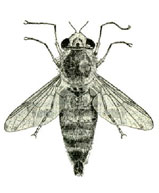
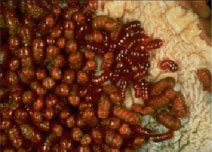
The nasal botfly larva (Gastrophilus intestinalis) is a reddish-brown, barrel-shaped larva, approximately 1.5 centimetres long, with several rows of spines on its body and strong mouth hooks.
Lifecycle
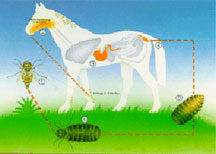
The fertilised females of the botfly fly at their victims and lay their eggs in the fur, sticking them there. The most common European species prefers to lay its eggs in the chest and abdominal area or on the legs.
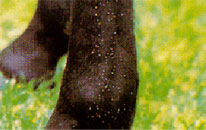
The larvae (larva I), which are deposited primarily on the forelegs, shoulders, and flanks, only hatch after contact with the host animal's saliva and attach themselves with their mouth hooks to the tongue or cheek. By licking these areas, the larvae I enter the oral cavity. They burrow into the mucous membrane of the oral cavity and remain there for three to four weeks. Swelling of the soft palate and inflammation of the tongue can occur, followed by difficulty chewing and swallowing.
Following their subsequent pupation and moult to larva II, they migrate to their actual settlement site in the stomach. Using their mouth hooks, as larva II and later as larva III, they burrow deep into the stomach lining, resulting in chronic gastritis with ulceration. Occasionally, gastric perforation with subsequent peritonitis even occurs.
The mature third-instar larvae are finally passed in the faeces after an eight- to ten-month period in the stomach, at the beginning of the warmer season. Their subsequent pupation takes place in the external environment. After a pupal rest of three to four weeks, the botflies hatch and begin egg-laying immediately after mating. The flies do not possess mouthparts for feeding. Therefore, they survive for a maximum of three weeks, during which they lay their eggs.
Recognition
Apart from gastroscopy, there are no reliable routine procedures available for detecting stomach bot larvae (Gasterophilus spp.) in horses. Larvae are also rarely found in faeces. In summer and autumn, the eggs laid on the hairs indicate an expected infestation. Clinical signs may include colic, fluctuating appetite, diarrhoea, emaciation, and anaemia. Particularly in foals, developmental disorders, reduced performance, decreased resistance, and, rarely, fatalities can be observed. Control
Medicinal killing of the larvae in the horses' digestive tract interrupts the developmental cycle. Suitable preparations can kill the migratory larvae and the already embedded botfly larvae. As many horses as possible should be treated to significantly reduce the risk of re-infection in the following summer.
Timing of deworming
To understand the recommended deworming period, it's important to know the life cycle of the stomach botfly. It's crucial to time the control measures for when the larvae have already migrated to the stomach. In Central Europe, the adult botflies have a short flight period from the end of June to August (occasionally into late October). The females prefer warm and sunny days for egg-laying. The hatched larvae (see life cycle) take approximately three to four weeks to migrate from the pharyngeal mucosa into the stomach.
Therefore, there is only a earliest date from which deworming should commence (not before mid-November), but no latest date. However, the horses should be dewormed at the latest before they are turned out onto pasture, to avoid contaminating the pasture with stage III larvae.
However, the longer the larvae remain in the stomach lining, the greater their harmful effects on your horse! As a supportive control measure, it is recommended to remove any eggs attached to the horses' coats.
Do you have any questions or would you like to make an appointment? Contact See us!