
I have already used leeches successfully for overfilled tendon sheaths, overfilled joints and swellings. In my opinion, leech therapy certainly does not replace the conventional use of anti-inflammatory drugs in the treatment of joint and tendon sheath inflammation, but rather offers an alternative or supplementary therapy with few side effects.
Naming
The medicinal leech (Hirudo medicinalis) is a representative of the genus of snakes. The word „Egel“ is derived from the Greek word „echis,“ which translates to "little snake." The association of the word "Egel" with disgust is therefore incorrect.
General
Leeches in the wild only live in clear and, above all, clean bodies of water; they do not tolerate any form of pollution. They spend almost their entire lives in water and only move to damp shores to reproduce. As a result of poorer water quality, leeches are now only rarely found in our waters, especially in shallow, low-calcium ponds. For medicinal purposes, leeches are now bred specifically. The leeches I use belong to the group of finished medicinal products according to § 2 (1) No. 1 of the German Medicines Act. This means that the leeches I use are hygienically flawless, and therefore the risk of infection with pathogens is low to non-existent.
Hedgehog treatment
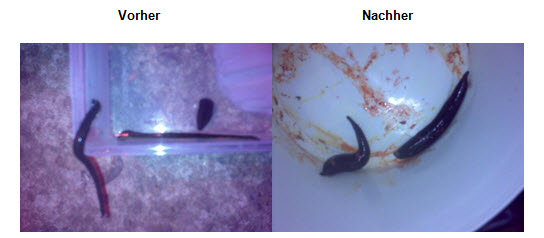
When starved, meaning at the point of being applied to a patient, leeches weigh between one and three grammes and their length is usually between four and twelve centimetres. When fully engorged and satisfied, the animals double or triple their actual circumference. The leech's body is relatively flat and both ends of the body have suckers for gripping.
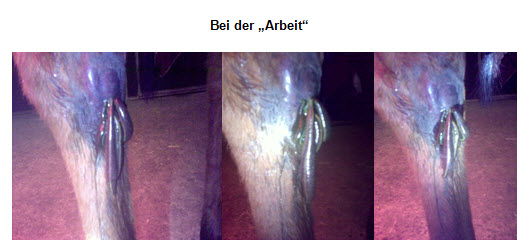
The leeches are placed on a clean, shaved area of skin near the region to be treated. This can be done using forceps or with your fingers.
The leeches require different amounts of time to latch on, although rarely longer than 2-3 minutes. It is interesting that the leeches „search“ for a bite site. It is presumed that they seek out the warmest spot within the vicinity of where they are placed and attach themselves there. The searching process can sometimes take several minutes; the notion that leeches immediately attach to anything that comes near their suckers is completely mistaken. The bite does not seem to be particularly unpleasant for the horses, as this procedure is met by the vast majority of horses with only occasional stamping of their feet. The bite is star-shaped (often referred to as the Mercedes star) and is caused by approximately 80 calcified teeth that rasp their way into the skin to reach the blood. Saliva (leech saliva) is released through openings between the teeth.
Once the leeches have finished, they simply fall off and can then be safely „disposed of“. At the bite site, the anticoagulants secreted by the leeches cause post-bleeding, which is completely normal and desirable. However, this only amounts to a few millilitres of blood.
Mechanisms of action of leeches
Meanwhile, there are several scientific studies and doctoral theses from human medicine in which “during the course of the investigations, leech therapy has been shown to be an accepted, well-tolerated, easily performed, and inexpensive method, despite its unclarified mechanism of action“ (STOCK 2009).
According to naturopathy, the effectiveness of leech therapy is based on several factors:
- the urge to bite itself
- Ingredients contained in and released by leech saliva
- the bloodletting itself
The saliva of leeches contains the following previously identified active ingredients: Hirudin (the main active ingredient inhibits blood clotting), Calin (a substance also responsible for blood clotting in saliva). It causes the wound to bleed again, which has a cleansing function and can be compared to gentle bloodletting.
Furthermore, the substances hyaluronidase, egline, bdellin, apyrase, collagenase, destabilase, piyavit, and others are contained in saliva. The functions and contents of all these substances have not yet been fully researched.
Do you have any questions or would you like to make an appointment? Contact See us!