
Eye examination without a trip to the clinic
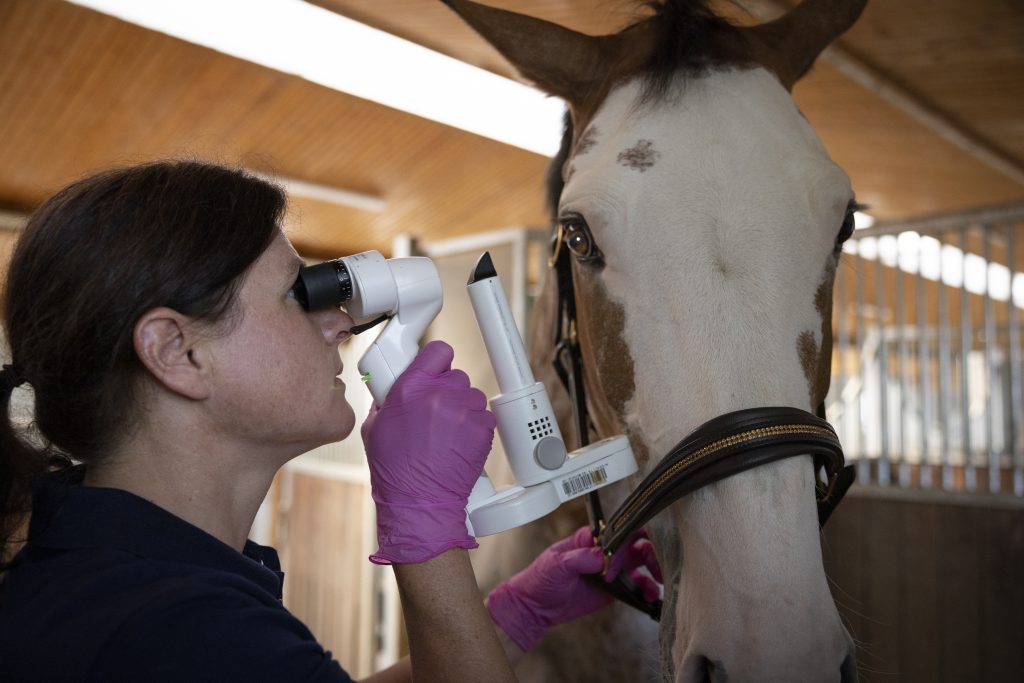
Your horse's eyes are sensitive, and small injuries can quickly become serious. We examine the eyes thoroughly directly in the stable, without a stressful trip to the clinic. We are members of the Working Group on Equine Ophthalmology and attend the latest training courses and congresses on this topic in Germany every year.
When you should contact us
Please contact us on the same day if your horse
- squints or has a very watery eye,
- is sensitive to light,
- has a cloudiness or a spot in the eye,
- has a red or swollen eye or eyelid,
- has a purulent discharge from the eye,
- has an injury to the eyelid – incomplete closure of the eyelid can permanently damage the eye,
- has blood in the anterior chamber of the eye.
Even seemingly harmless injuries to the eye can lead to permanent damage without treatment.
How we examine
We start with a clinical examination: behaviour, pupillary light reflexes and external signs. Depending on the findings, we use:
- Ophthalmoscope: the entire eye from the cornea to the back of the eye (retina)
- Slit lamp: cornea, lens, iris and fundus
- Fluorescein test: makes the smallest corneal injuries visible
- Tonometer: measures the intraocular pressure, e.g. in cases of suspected glaucoma or ERU
- Ultrasound: vitreous body, lens, eye chambers and retina
- Laboratory samples: microbiological, mycological or pathological
Treatment
Depending on the findings, we use targeted treatment:
- selected eye ointments
- Eye injections
- Tear duct flushing
All treatments are carried out under sterile conditions and as gently as possible. Early examinations help to detect diseases such as conjunctivitis, corneal defects, immune-mediated keratitis (IMMK), glaucoma or ERU (moon blindness) in good time. More on the most common diseases: Uveitis and Corneal defects.
Frequently asked questions
Is a corneal injury an emergency?
Yes, it should be examined on the same day because it can deteriorate quickly.
Does my horse need to be sedated for the examination?
In most cases, a complete eye examination can be performed patiently without sedation. If the eye is very painful, sedation is sometimes recommended, as otherwise not all examinations will be possible and an important detail could be overlooked.
Is your horse stabled in the greater Düsseldorf area?
Our team of vets comes to your yard – from Duisburg and Krefeld via Neuss and Mönchengladbach to Mettmann and Dormagen.
Call: +49 151 23063527WhatsApp us